 Add to Chrome
 Add to Firefox
 Add to Edge
Variational Learning for Insertion-based Generation
Jun 01, 2026
Non-monotonic sequence generation methods, such as masked diffusion models, provide a flexible alternative to left-to-right autoregressive modeling by allowing tokens to be generated in non-fixed and prescribed orders. Despite their practical advantages, most existing non-monotonic models are order-agnostic and rely on a fixed-length grid, limiting their ability to support variable-length generation and adaptive insertion order. In this work, we introduce a probabilistic framework for learning insertion order in variable-length insertion models. We formalize a bijective correspondence between insertion trajectories and permutations, which enables an exact reparameterization of the data likelihood as a sum over permutations. Building on this result, we propose the Insertion Process (IP), a stochastic generative model that jointly learns where to insert, what to insert, and when to terminate, trained via permutation-based variational inference. Unlike prior fixed-canvas approaches, IP natively supports variable-length generation and learns data-driven preferences over insertion orders. Experiments on goal-conditioned planning and molecular string generation demonstrate that learning insertion order improves both modeling quality and generalization in domains without a canonical left-to-right structure.

The Efficiency Gap in Byte Modeling
May 13, 2026Modern language models have historically relied on two dominant design choices: subword tokenization and autoregressive (AR) ordering. These design decisions bake in priors that dictate a model's learning. Recently, two alternative paradigms have challenged this: byte-level modeling, which bypasses static statistically-derived token vocabularies, and masked diffusion modeling (MDM), which conducts parallel, non-sequential generation. Their intersection represents a fully end-to-end modality-agnostic generative prototype; however, removing these structural priors incurs a significant computational cost. In this work, we investigate this cost through a compute-matched scaling study. Our results reveal that the performance penalty of byte modeling is not uniform; across scale, the scaling overhead of byte modeling is worse for MDM than for AR. We hypothesize that this disparity stems from context fragility: while AR's stable causal history allows models to naturally rediscover subword patterns, the MDM objective destroys the local contiguity required to efficiently resolve semantics from raw bytes. Our findings from controlled permutation experiments suggest that future modality-agnostic designs must incorporate alternative structural biases to maintain viable scaling trajectories in the byte regime.
RealCam: Real-Time Novel-View Video Generation with Interactive Camera Control
May 07, 2026Camera-controlled video-to-video (V2V) generation enables dynamic viewpoint synthesis from monocular footage, holding immense potential for interactive filmmaking and live broadcasting. However, existing implicit synthesis methods fundamentally rely on non-causal, full-sequence processing and rigid prefix-style temporal concatenation. This architectural paradigm mandates bidirectional attention, resulting in prohibitive computational latency, quadratic complexity scaling, and inherent incompatibility with real-time streaming or variable-length inputs. To overcome these limitations, we introduce \texttt{RealCam}, a novel autoregressive framework for interactive, real-time camera-controlled V2V generation. We first design a high-fidelity teacher model grounded in a \textbf{Cross-frame In-context Learning} paradigm. By interleaving source and target frames into synchronized contextual pairs, our design inherently enables length-agnostic generalization and naturally facilitates causal adaptation, breaking the rigid prefix bottleneck. We then distill this teacher into a few-step causal student via Self-Forcing with Distribution Matching Distillation, enabling efficient, on-the-fly streaming synthesis. Furthermore, to mitigate severe loop inconsistency in closed-loop trajectories, we propose \textbf{Loop-Closed Data Augmentation (LoopAug)}, a novel paradigm that synthesizes globally consistent loop sequences from existing multiview datasets. Extensive experiments demonstrate that \texttt{RealCam} achieves state-of-the-art visual fidelity and temporal consistency while enabling truly interactive camera control with orders-of-magnitude faster inference than existing paradigms. Our project page is at https://xyc-fly.github.io/RealCam/.
PASR: Pose-Aware 3D Shape Retrieval from Occluded Single Views
Apr 24, 2026Single-view 3D shape retrieval is a fundamental yet challenging task that is increasingly important with the growth of available 3D data. Existing approaches largely fall into two categories: those using contrastive learning to map point cloud features into existing vision-language spaces and those that learn a common embedding space for 2D images and 3D shapes. However, these feed-forward, holistic alignments are often difficult to interpret, which in turn limits their robustness and generalization to real-world applications. To address this problem, we propose Pose-Aware 3D Shape Retrieval (PASR), a framework that formulates retrieval as a feature-level analysis-by-synthesis problem by distilling knowledge from a 2D foundation model (DINOv3) into a 3D encoder. By aligning pose-conditioned 3D projections with 2D feature maps, our method bridges the gap between real-world images and synthetic meshes. During inference, PASR performs a test-time optimization via analysis-by-synthesis, jointly searching for the shape and pose that best reconstruct the patch-level feature map of the input image. This synthesis-based optimization is inherently robust to partial occlusion and sensitive to fine-grained geometric details. PASR substantially outperforms existing methods on both clean and occluded 3D shape retrieval datasets by a wide margin. Additionally, PASR demonstrates strong multi-task capabilities, achieving robust shape retrieval, competitive pose estimation, and accurate category classification within a single framework.
DiT as Real-Time Rerenderer: Streaming Video Stylization with Autoregressive Diffusion Transformer
Apr 15, 2026Recent advances in video generation models has significantly accelerated video generation and related downstream tasks. Among these, video stylization holds important research value in areas such as immersive applications and artistic creation, attracting widespread attention. However, existing diffusion-based video stylization methods struggle to maintain stability and consistency when processing long videos, and their high computational cost and multi-step denoising make them difficult to apply in practical scenarios. In this work, we propose RTR-DiT (DiT as Real-Time Rerenderer), a steaming video stylization framework built upon Diffusion Transformer. We first fine-tune a bidirectional teacher model on a curated video stylization dataset, supporting both text-guided and reference-guided video stylization tasks, and subsequently distill it into a few-step autoregressive model via post-training with Self Forcing and Distribution Matching Distillation. Furthermore, we propose a reference-preserving KV cache update strategy that not only enables stable and consistent processing of long videos, but also supports real-time switching between text prompts and reference images. Experimental results show that RTR-DiT outperforms existing methods in both text-guided and reference-guided video stylization tasks, in terms of quantitative metrics and visual quality, and demonstrates excellent performance in real-time long video stylization and interactive style-switching applications.
Generative Frontiers: Why Evaluation Matters for Diffusion Language Models
Apr 03, 2026Diffusion language models have seen exciting recent progress, offering far more flexibility in generative trajectories than autoregressive models. This flexibility has motivated a growing body of research into new approaches to diffusion language modeling, which typically begins at the scale of GPT-2 small (150 million parameters). However, these advances introduce new issues with evaluation methodology. In this technical note, we discuss the limitations of current methodology and propose principled augmentations to ensure reliable comparisons. We first discuss why OpenWebText has become the standard benchmark, and why alternatives such as LM1B are inherently less meaningful. We then discuss the limitations of likelihood evaluations for diffusion models, and explain why relying on generative perplexity alone as a metric can lead to uninformative results. To address this, we show that generative perplexity and entropy are two components of the KL divergence to a reference distribution. This decomposition explains generative perplexity's sensitivity to entropy, and naturally suggests generative frontiers as a principled method for evaluating model generative quality. We conclude with empirical observations on model quality at this scale. We include a blog post with interactive content to illustrate the argument at https://patrickpynadath1.github.io/blog/eval_methodology/.
CoMo: Compositional Motion Customization for Text-to-Video Generation
Oct 27, 2025While recent text-to-video models excel at generating diverse scenes, they struggle with precise motion control, particularly for complex, multi-subject motions. Although methods for single-motion customization have been developed to address this gap, they fail in compositional scenarios due to two primary challenges: motion-appearance entanglement and ineffective multi-motion blending. This paper introduces CoMo, a novel framework for $\textbf{compositional motion customization}$ in text-to-video generation, enabling the synthesis of multiple, distinct motions within a single video. CoMo addresses these issues through a two-phase approach. First, in the single-motion learning phase, a static-dynamic decoupled tuning paradigm disentangles motion from appearance to learn a motion-specific module. Second, in the multi-motion composition phase, a plug-and-play divide-and-merge strategy composes these learned motions without additional training by spatially isolating their influence during the denoising process. To facilitate research in this new domain, we also introduce a new benchmark and a novel evaluation metric designed to assess multi-motion fidelity and blending. Extensive experiments demonstrate that CoMo achieves state-of-the-art performance, significantly advancing the capabilities of controllable video generation. Our project page is at https://como6.github.io/.
CANDI: Hybrid Discrete-Continuous Diffusion Models
Oct 26, 2025While continuous diffusion has shown remarkable success in continuous domains such as image generation, its direct application to discrete data has underperformed compared to purely discrete formulations. This gap is counterintuitive, given that continuous diffusion learns score functions that enable joint evolution across multiple positions. To understand this gap, we introduce token identifiability as an analytical framework for understanding how Gaussian noise corrupts discrete data through two mechanisms: discrete identity corruption and continuous rank degradation. We reveal that these mechanisms scale differently with vocabulary size, creating a temporal dissonance: at noise levels where discrete corruption preserves enough structure for conditional learning, continuous denoising is trivial; at noise levels where continuous denoising is meaningful, discrete corruption destroys nearly all conditional structure. To solve this, we propose CANDI (Continuous ANd DIscrete diffusion), a hybrid framework that decouples discrete and continuous corruption, enabling simultaneous learning of both conditional structure and continuous geometry. We empirically validate the temporal dissonance phenomenon and demonstrate that CANDI successfully avoids it. This unlocks the benefits of continuous diffusion for discrete spaces: on controlled generation, CANDI enables classifier-based guidance with off-the-shelf classifiers through simple gradient addition; on text generation, CANDI outperforms masked diffusion at low NFE, demonstrating the value of learning continuous gradients for discrete spaces.
Learning-Order Autoregressive Models with Application to Molecular Graph Generation
Mar 07, 2025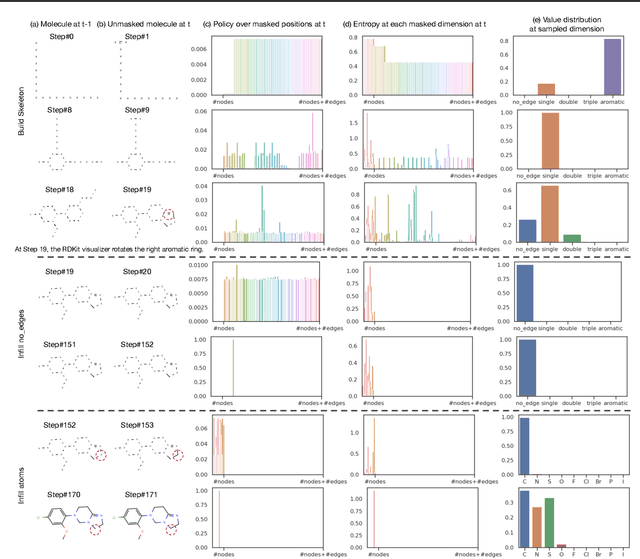
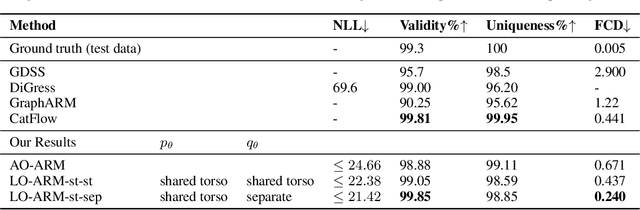
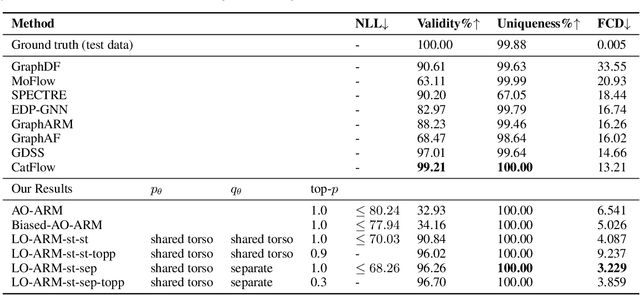
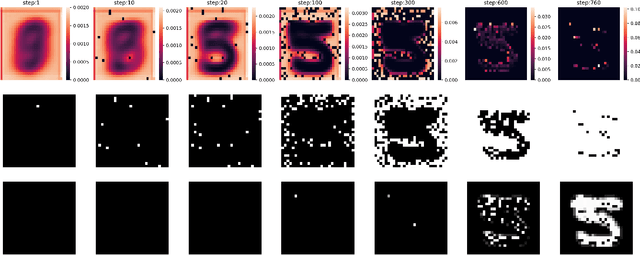
Autoregressive models (ARMs) have become the workhorse for sequence generation tasks, since many problems can be modeled as next-token prediction. While there appears to be a natural ordering for text (i.e., left-to-right), for many data types, such as graphs, the canonical ordering is less obvious. To address this problem, we introduce a variant of ARM that generates high-dimensional data using a probabilistic ordering that is sequentially inferred from data. This model incorporates a trainable probability distribution, referred to as an \emph{order-policy}, that dynamically decides the autoregressive order in a state-dependent manner. To train the model, we introduce a variational lower bound on the exact log-likelihood, which we optimize with stochastic gradient estimation. We demonstrate experimentally that our method can learn meaningful autoregressive orderings in image and graph generation. On the challenging domain of molecular graph generation, we achieve state-of-the-art results on the QM9 and ZINC250k benchmarks, evaluated using the Fr\'{e}chet ChemNet Distance (FCD).
Test-time regression: a unifying framework for designing sequence models with associative memory
Jan 21, 2025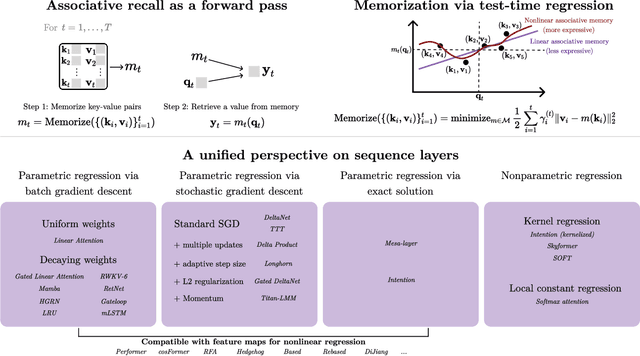
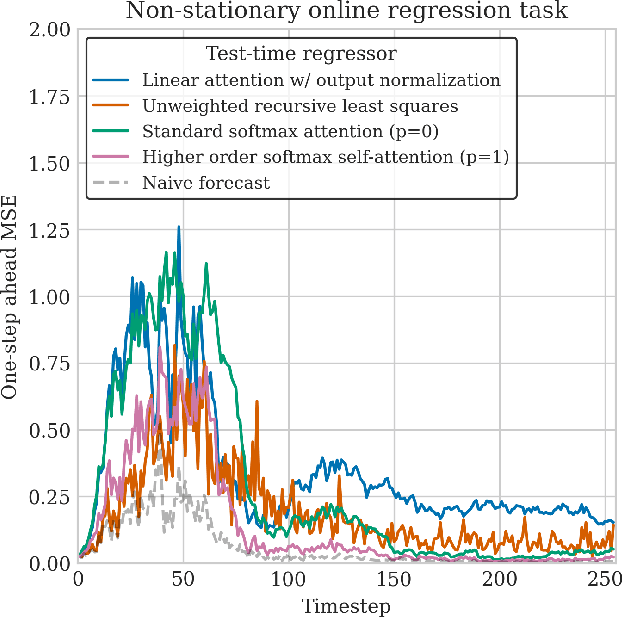
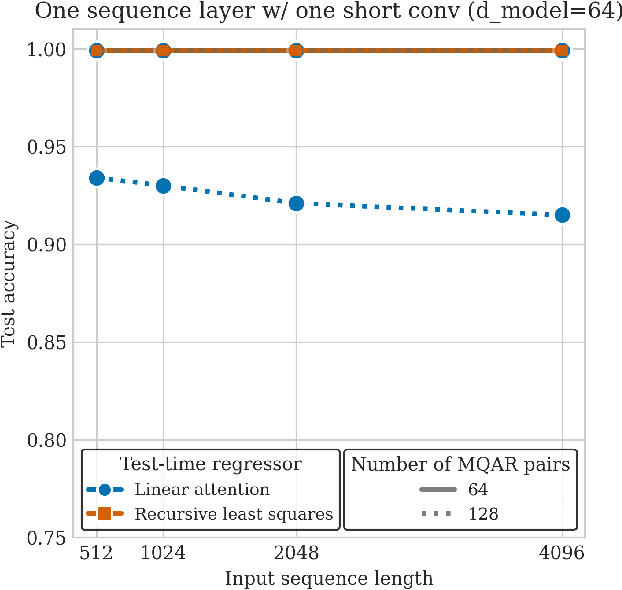
Sequences provide a remarkably general way to represent and process information. This powerful abstraction has placed sequence modeling at the center of modern deep learning applications, inspiring numerous architectures from transformers to recurrent networks. While this fragmented development has yielded powerful models, it has left us without a unified framework to understand their fundamental similarities and explain their effectiveness. We present a unifying framework motivated by an empirical observation: effective sequence models must be able to perform associative recall. Our key insight is that memorizing input tokens through an associative memory is equivalent to performing regression at test-time. This regression-memory correspondence provides a framework for deriving sequence models that can perform associative recall, offering a systematic lens to understand seemingly ad-hoc architectural choices. We show numerous recent architectures -- including linear attention models, their gated variants, state-space models, online learners, and softmax attention -- emerge naturally as specific approaches to test-time regression. Each architecture corresponds to three design choices: the relative importance of each association, the regressor function class, and the optimization algorithm. This connection leads to new understanding: we provide theoretical justification for QKNorm in softmax attention, and we motivate higher-order generalizations of softmax attention. Beyond unification, our work unlocks decades of rich statistical tools that can guide future development of more powerful yet principled sequence models.